



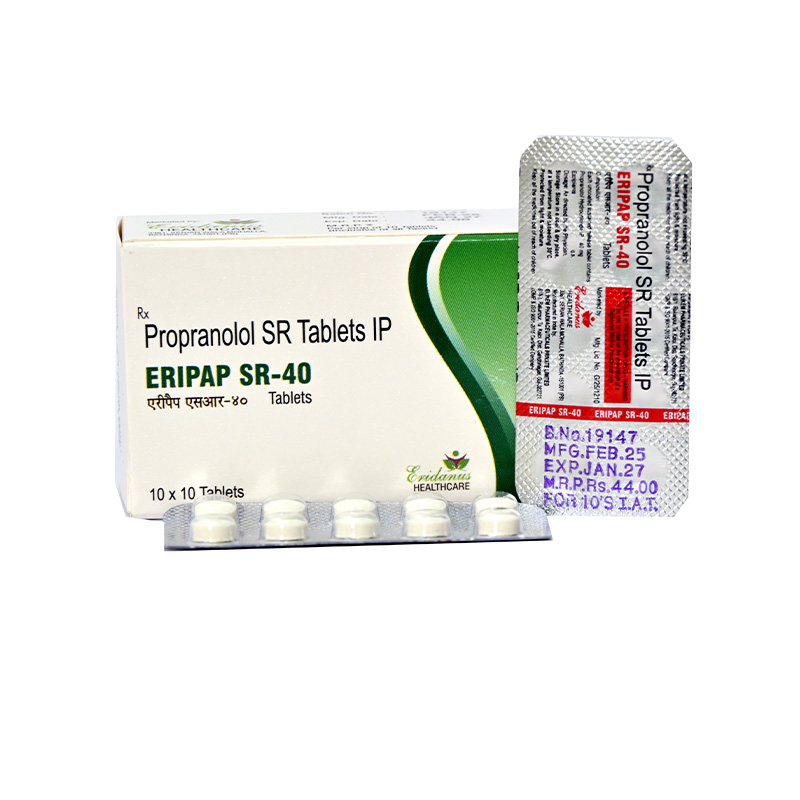

ERIPAP SR-40 – Propranolol Hydrochloride SR 40mg Tablets
Propranolol has a short plasma half-life, which in immediate-release form means dosing two or three times daily and a corresponding rise and fall in beta blockade across the day. In migraine prophylaxis and essential tremor, where the objective is continuous suppression rather than intermittent relief, that fluctuation works against the indication. ERIPAP SR-40 delivers 40mg in sustained-release form for once-daily administration.
Product Specifications
Brand Name: ERIPAP SR-40
Composition: Propranolol Hydrochloride 40 mg (Sustained Release)
Dosage Form: Sustained Release Tablet
Therapeutic Category: Neuropsychiatry, CNS
Manufacturing: WHO-GMP certified facility
Prescription Status: Schedule H
Storage: Store below 25°C, protect from light and moisture
Composition
Propranolol Hydrochloride — 40 mg (Sustained Release) — Non-selective beta-adrenergic receptor antagonist; lipophilic, crosses the blood-brain barrier
Mechanism of Action
Propranolol blocks both beta-1 and beta-2 adrenergic receptors without selectivity. Its lipophilicity allows central nervous system penetration, which cardioselective agents such as atenolol and metoprolol achieve to a far lesser degree, and this underlies its established role in migraine prophylaxis and essential tremor rather than purely cardiovascular indications.
The sustained-release matrix alters delivery rather than mechanism. Propranolol is cleared rapidly, so immediate-release dosing produces peaks and troughs across the day. Gradual release maintains beta blockade within a narrower band over the dosing interval, which matters in prophylactic use where the therapeutic aim is preventing events rather than treating them — a trough in coverage is a window in which a migraine can initiate.
Clinical Applications
- Migraine prophylaxis
- Essential tremor requiring continuous control
- Generalised anxiety with persistent somatic symptoms
- Akathisia and antipsychotic-induced tremor
- Hypertension and angina, as part of a titrated regimen
- Adjunct in thyrotoxicosis for symptomatic control
Why the Sustained-Release Format Matters in Prophylaxis
Immediate-release Propranolol requires two to three doses daily. In prophylactic indications that continue over months, each additional daily dose is a further point at which adherence can lapse, and in migraine prophylaxis specifically, inconsistent dosing undermines the assessment of whether the drug is working at all — a breakthrough attack following a missed dose is difficult to distinguish from treatment failure.
Once-daily administration removes that variable, which is relevant both to clinical outcome and to how confidently a prescriber can evaluate response before adjusting therapy.
Prescriber Profile
Neurologists form the primary prescribing base, particularly in migraine prophylaxis and essential tremor where sustained coverage is the therapeutic objective. Psychiatrists prescribe it in generalised anxiety with persistent somatic presentation and in antipsychotic-induced akathisia. Physicians and cardiologists account for cardiovascular indications.
Dosage and Administration
As prescribed by a Registered Medical Practitioner, with dose determined by indication and titrated as clinically appropriate. Sustained-release tablets are swallowed whole and must not be crushed, split or chewed, as this releases the full dose at once and defeats the controlled-release profile. This is a Schedule H drug — sale by retail is permitted only against the prescription of a Registered Medical Practitioner.
Safety Information
Propranolol is non-selective, so beta-2 blockade affects bronchial smooth muscle. It is contraindicated in bronchial asthma and used with caution in chronic obstructive pulmonary disease, where bronchospasm may be precipitated. This distinction from cardioselective beta blockers should be established before prescribing.
Treatment must not be discontinued abruptly, as sudden withdrawal can precipitate rebound tachycardia, angina or arrhythmia — dose reduction should be gradual and physician-supervised. Caution is required in diabetes, since beta blockade can mask the adrenergic warning signs of hypoglycaemia. Contraindicated in significant bradycardia, second or third degree heart block, and decompensated cardiac failure. Store below 25°C, protect from light and moisture. Keep out of reach of children.
Range Positioning
ERIPAP SR-40 completes the Propranolol strength ladder alongside ERIPAP-10, covering both the low-dose initiation strength and the once-daily sustained-release format used in maintenance prophylaxis. A neurologist starting a migraine patient on immediate-release and moving to once-daily maintenance has no reason for the prescription to leave the range at the point of switch.
PCD Pharma Franchise Availability
ERIPAP SR-40 is available across India for neuropsychiatry PCD Pharma Franchise association, with territory rights allotted on a monopoly basis subject to availability. Associates receive promotional inputs and product literature across the neuropsychiatry and CNS range. Trade enquiries may be directed to Eridanus Healthcare.
Frequently Asked Questions
Why is Propranolol supplied in sustained-release form?
Propranolol has a short plasma half-life, so immediate-release dosing requires two to three doses daily with corresponding peaks and troughs in beta blockade. Sustained release maintains coverage across the dosing interval with once-daily administration.
What distinguishes ERIPAP SR-40 from ERIPAP-10?
ERIPAP-10 is the low-dose immediate-release strength used for initiation and symptomatic control. ERIPAP SR-40 is the once-daily sustained-release format used where continuous prophylactic coverage is the objective.
Can the sustained-release tablet be split or crushed?
No. Splitting or crushing releases the full dose at once, removing the controlled-release profile and altering intended exposure.
How does Propranolol differ from atenolol or metoprolol?
Propranolol is non-selective and lipophilic enough to cross the blood-brain barrier. Cardioselective agents are more beta-1 specific and penetrate the central nervous system less, which is why they are not equivalent in migraine prophylaxis or essential tremor.
Why can Propranolol not be used in asthma?
Beta-2 blockade affects bronchial smooth muscle and may precipitate bronchospasm, making it contraindicated in bronchial asthma and requiring caution in COPD.
Which prescribers form the primary target base?
Neurologists and psychiatrists account for the majority of prescribing at this strength, with physicians and cardiologists as additional coverage — relevant when building a neuropsychiatry portfolio through PCD Pharma Franchise association.
Why stock both ERIPAP-10 and ERIPAP SR-40?
Carrying the full strength ladder allows a prescriber to initiate on immediate-release and transition to once-daily maintenance without changing brand, which protects the prescription once established.
How may a distributor enquire about territory rights?
Distributors and pharmaceutical professionals holding a valid Drug Licence and GST registration may contact Eridanus Healthcare to discuss availability and terms.
This page is intended for pharmaceutical distributors, wholesalers, and healthcare professionals. Product information is provided for commercial and educational reference and is not a substitute for professional medical advice. Eridanus Healthcare does not sell directly to patients. This is a Schedule H drug — to be sold by retail only on the prescription of a Registered Medical Practitioner. All trade enquiries are subject to valid Drug Licence and GST verification.